


Blog Post
The cannabis and hemp beverage space moves faster than the news cycle can keep up.
That’s exactly why we launched Vertosa Unfiltered: Ask Us Anything, a live webinar series designed to give our partners, customers, and industry friends a direct line to our leadership team during one of the most pivotal regulatory moments in hemp’s history.
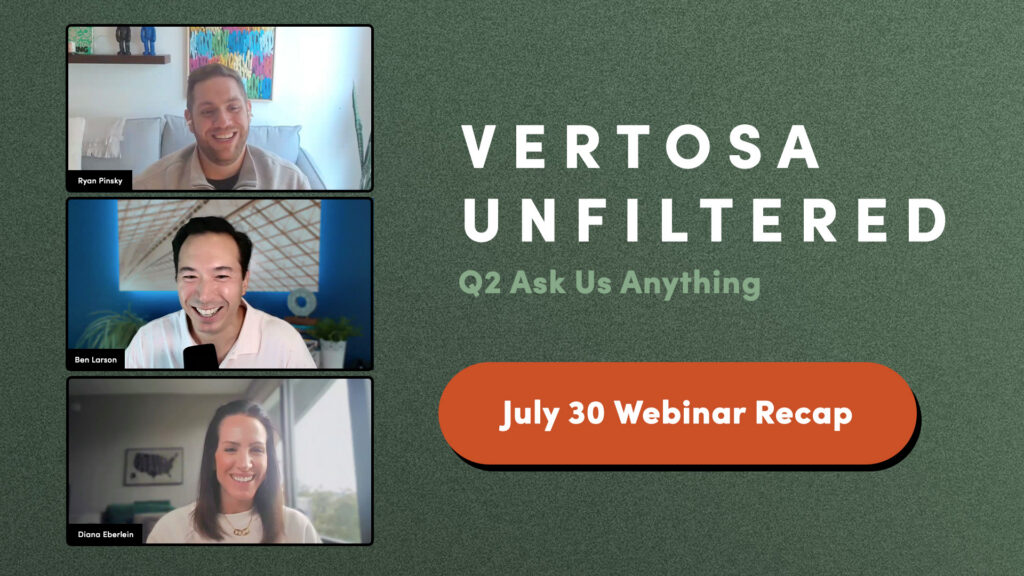
On July 30th, Vertosa’s Ben Larson (CEO), Ryan Pinsky (EVP, Revenue), and Diana Eberlein (CCO) sat down for an honest and unfiltered conversation answering questions submitted by the attendees and providing insights about the current state of our industry.
Here are the five biggest takeaways:
1. The most likely short-term move: a December extension.
With the November 12th federal deadline looming, the question on everyone’s mind is “What actually happens next?” Diana, who has been on the front lines of federal lobbying, gave her most candid read of the situation.
“If I was a betting woman, I think the September CR (Continuing Resolution) could have an extension that takes us into December for an end of year package. Voting on a complete budget in September before an election can be complicated, and frankly, they just don’t have that much time.”
As we now know, Diana hit the nail on the head here, as activity surrounding the Senate CR and the December extension heated up the day after our webinar. The bottom line: an extension is a starting point and an indicator that there is interest in regulating hemp, versus a ban. The Hill continues to debate hemp as we speak..
2. State-level hemp programs will be very hard to support if the ban takes effect.
One of the most sobering conversations was regarding what a federal ban means at the operational level within states that have passed hemp regulation. Ryan, who works hands-on with brands across both regulated and hemp markets, discussed the cascading complexity that would hit the supply chain:
“Are we going to see hemp state rights really stand? I think that’s a big question on a lot of people’s minds.”
When state laws conflict with federal law, supply chains and operations quickly become more complicated. Sourcing and manufacturing must stay within each state, products can no longer move across state lines, and distribution networks have to be rebuilt from scratch. Add in banking and credit card processing limitations, along with the tax burden created by 280E, and the infrastructure strain of a ban would be immense.
3. Retailers don’t need more confidence, they need the hard truth.
A question came in from a brand asking for messaging help to instill confidence in retailers. Diana’s response reframed the entire conversation:
“I think most retailers have confidence in the category. I think we don’t need to prove that anymore. We’ve seen the volume. We’re seeing growth across all retail channels. We’re seeing Target expand. We are seeing Albertsons test this in their Jewel-Osco retail locations in Illinois. I think we need to make it very clear to them that this could very much go away.”
The conversation to have with your retail partners isn’t about proving the category. It’s about the regulatory landscape, what a contingency plan looks like, and conveying the sobering truth that it’s an ‘all hands on deck’ moment to support the category. The call-to-action is clear: Get your retailers activated and reaching out to their state representatives to reject a hemp ban and support regulation.
4. Through all the uncertainty, one thing hasn’t changed: Consumer demand.
In the middle of regulatory chaos, it’s easy to lose sight of what’s stable. Diana brought it back to the fundamentals:
“What’s not changing is your target consumer and what they want. Understanding that target consumer and the fact that they’ve been purchasing your product, they have a specific lifestyle, and applying that to your potential pivot strategy. It’s just figuring out how to get them something that might be different or a little safer for the regulatory timeline right now.”
Consumers who love your product haven’t gone anywhere. Your brand equity and your consumer relationship are assets worth protecting, even if the format or channel has to shift temporarily while we fight to establish federal clarity and regulation.
5. One smart way to protect shelf space: Launch a .4mg low-dose bev.
One common question our team received was what can brands do right now to stay in the game. Ryan discussed the very low-dose THC beverage option as a practical bridge strategy:
“As someone who has been experimenting with .4 milligram drinks for quite some time, I really enjoy it…on-premise is where I really see the big advantage.”
Brands manufacturing low-dose products are holding shelf space, maintaining retailer relationships, and staying in front of consumers while the regulatory picture becomes clearer. It’s not a permanent solution, but it may be a smart one.
Q2 Surprises: Rapid fire round
We closed out the webinar by asking our leadership team to reflect on what’s caught them off guard throughout this wild year:
Ryan was most surprised by the sheer entrepreneurial resilience of the industry. Brands with their backs against the wall have been making smart, creative pivots by entering new markets, launching new SKUs, and finding new retail partners.
Diana noted the sheer amount of progress made on the Hill. Two years ago, lobbyists had to explain what a THC beverage was. Today, it’s holding up federal budget conversations. The movement is real!
Ben commented on how willing some players are to put up walls and block progress, purely to protect their own profits. Equally surprising to him is the sheer amount of voices willing to stand up for true advocacy and destigmatization.
Missed the live webinar? View the recording here.
We’ll be back with another edition of Vertosa Unfiltered: Ask Us Anything soon. In the meantime, keep sending your questions, keep engaging your representatives, and keep building. We’ll be right there with you.