


Blog Post
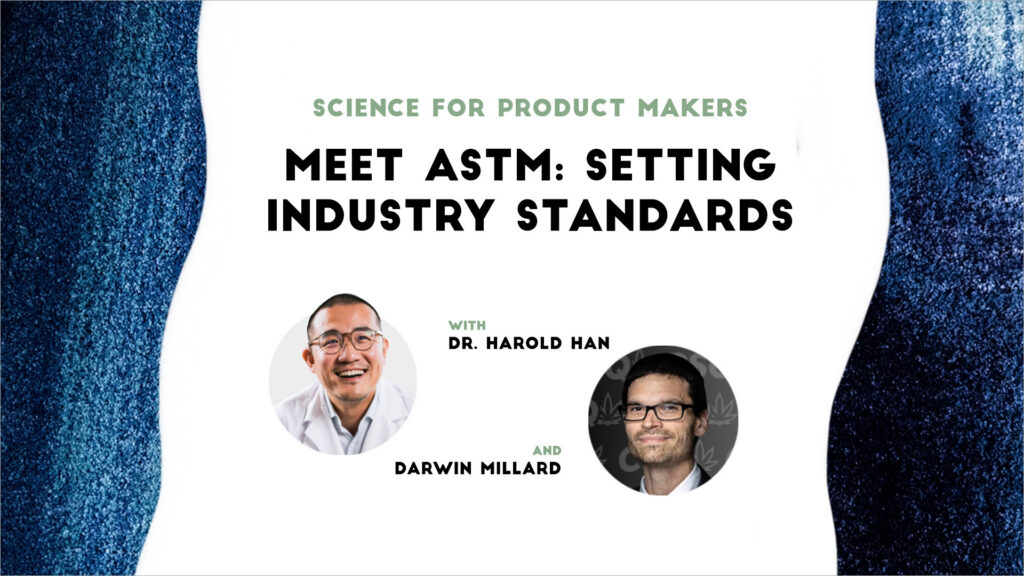
This post was originally published on August 5, 2026, as an article on Harold’s LinkedIn profile. You can read and leave comments here.
Every mature industry has a foundation of standards that were built to support it. You probably aren’t aware of them, but they are working quietly every time you open a can of soda, take medication, or drive across a bridge. Those guardrails were built slowly, rigorously, and collaboratively by the scientists and engineers who cared enough to do the work before the market demanded it.
The cannabinoid beverage industry is at that inflection point right now.
Millions of people are consuming cannabinoid-containing beverages every day, the market is growing dramatically, and the products are getting more sophisticated. The supply chain, from emulsion manufacturers to can suppliers to beverage brands, is maturing. And yet, until very recently, we have been operating largely without industry standards that allow us to scale with confidence.
That is starting to change. Today, I invited Darwin Millard, expert on quality and standards, to share the foundation of building standards for cannabis beverages.
Standards Matter More Than You’d Think
Here is a question I get asked a lot in this industry: Why do we need formal standards? Can’t brands just test their own products?
The short answer is yes, they can, and they do. But individual testing, without shared methods and agreed-upon specifications, creates a fragmented landscape where every company is essentially speaking a different language. One lab’s “stable emulsion” is another lab’s “acceptable variance.” One brand’s “good shelf life” is another brand’s “acceptable potency loss.” Without a common reference point, there is no real accountability nor trust.
Standards create a shared language and define what “good” means in measurable, reproducible terms. They allow brands, suppliers, and labs to align. When the industry eventually faces more regulatory scrutiny, having established, third-party-validated standards already in place will be the difference between leading the conversation and reacting to it.
More than that, standards are a form of collective wisdom. They represent the combined knowledge of people in an industry working together, and aligning on the right way to do something. That wisdom deserves to be preserved, debated, and built upon, not scattered across proprietary SOPs inside individual companies.
ASTM International: The Right Organization for the Job
When deciding to pursue formal standards for the cannabinoid beverage industry, the question of “who” matters as much as “what”. We need an organization that’s credible, globally recognized, and has a process that can hold up to scrutiny.
ASTM International has been developing voluntary consensus standards since 1898. Today, they have published more than 12,000 standards used across virtually every industry: materials science, construction, aerospace, healthcare, consumer products, etc. It is one of the most trusted international standards organizations in the world, with more than 35,000 member-volunteers from over 140 countries contributing to their expertise. Its process is open, transparent, and designed to prevent any single company or interest from controlling the outcome.
That last point is critical. ASTM Standards are not written by one company and handed to the industry. They are built through consensus, meaning the standard only moves forward when a broad cross-section of experts, including people who may be competitors in the market, reach agreements. Every objection must be considered and addressed. No one gets to steamroll the process.
For a new industry that needs standards the market will trust, ASTM International is the right group to tackle this.
How ASTM Standards Get Made
The ASTM process is intentionally slow, I say that as a compliment!
It starts with a committee member submitting a formal proposal that a new standard is needed. A working group of subject matter experts is then formed to draft the standard. These groups can and often do include competitors. At the committee level, market competition is irrelevant. The focus is to align on the industrial truth.
The working group drafts the standard, debating testing methods, acceptable limits, validation requirements, and scope. If there are competing proposed methods for measurement, third-party laboratories are engaged to perform validation studies, running the methods against real samples to determine which is more accurate, reproducible, and practical. This is not a theoretical exercise. The methods have to actually work.
Once the working group reaches alignment, the draft is opened to the broader committee membership and, critically, to the public. Anyone can submit a comment. Every comment receives a formal response. This open review is where the standard gets stress-tested by people who were not in the room when it was drafted.
The draft standard is first voted on by the members of the subcommittee where the work item originated. After the draft has passed the subcommittee, it is voted on by the members of the main committee. Only after all objections are addressed and the draft passes both subcommittee and main committee ballots does the standard get published and become an ASTM Standard. At that time, it becomes a living document that can be revised at any time as technology and industry knowledge evolve.
This is a lengthy process by design. A standard that moves too fast will have gaps, and a standard that is not stress-tested will fail in the field. The rigor is the point.
What excites me most is watching this process unfold in real time for the cannabis industry. ASTM is actively developing standards across input quality, processing, laboratory testing, and beyond. Every new standard published is a signal to the broader market: this industry is doing the work to hold itself accountable. Standards are the clear indicators that an industry is ready for it. My next article will share progress on three ASTM standards around cannabis infused beverages. Stay tuned.
Dr. Harold Han — the “Happy Chemist” — combines his storied background in emulsion chemistry and science with curiosity and fascination in the rapidly growing cannabis industry. Developing nano and micro emulsions his entire career, Harold holds a Ph.D in Surface Chemistry from NYU and is the holder of multiple patents for his inventions in emulsion chemistry.
As the Chief Science Officer at Vertosa, Harold spearheads the company’s development of industry-leading and customized active ingredients for infused product makers, offering pre-suspended aqueous solutions to create incredibly homogenous and stable products while maximizing bioavailability, clarity, and taste.
To learn more about the science of cannabis, make sure to follow Harold on LinkedIn and check out his Happy Chemist videos.