


Blog Post
This post was originally published on October 29, 2026, as an article on Harold’s LinkedIn profile. You can read and leave comments here.
If you caught our last piece on ASTM and how their standards get made, you already know why their involvement in cannabis matters. Now we’re putting that process in context with real examples.
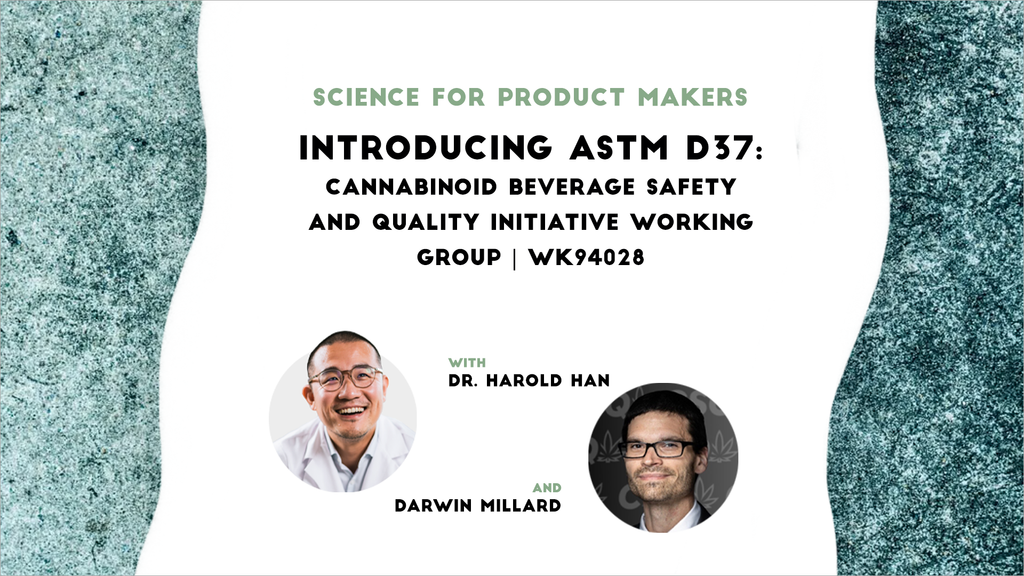
In this article, we will introduce the ASTM D37 Cannabinoid Beverage Safety and Quality Initiative (Working Group for short) and walk through four new standards related to the stability and quality of cannabis/hemp cannabinoid beverages.
The Working Group was established to foster collaboration between industry experts, consumers, and regulators of cannabinoid-containing beverage products. Its focused efforts aim to develop quality and safety standards, ensuring product reliability and consumer and environmental protection.
The standards this Working Group will prioritize include terminology, classifications, specifications, and test methods that will help with the analysis and characterization of chemical constituents, selection of materials, and normalization of industry best practices for cannabinoid beverages.
Areas of focus:
- Stability & performance
- Product declarations
- Manufacturability
- Retail, warehousing, and distribution
The Working Group is being led by Darwin Millard, Technical Director of Cannabis Safety and Quality (CSQ). Contributing members include: Vertosa, SōRSE, Anresco, High Spirits, Hemp Beverage Alliance, Metrohm, and the Coalition for Adult Beverage Alternatives, among others.
What we built: Four standards for the cannabinoid beverage industry
The ASTM D37 Cannabinoid Beverage Safety and Quality Initiative Working Group has submitted four work items to ASTM International. Together, they form an interlocking set of guardrails for the two most critical variables in this industry: emulsion quality and can liner integrity.
All four work items will go through public comments before they are recognized as formal standards.
Standard 1: New Specification for Stability of Pre-Made Liquid Cannabinoid Emulsions Intended for Use as Ingredients in Cannabinoid-Infused Beverages (WK99740)
Emulsions are the engine of the cannabinoid beverage industry. Most cannabinoid beverages on the market today use advanced emulsion technology to deliver cannabinoids into water-based liquid in a stable, homogeneous, bioavailable form. Vertosa’s emulsions are behind a significant share of what you see on shelves, and we have learned from years in this space is that emulsion quality is the single most impactful variable in beverage quality, consistency, and shelf life.
Until now, there has been no agreed-upon industry standard for what a “stable” emulsion actually means. Emulsion suppliers declare their own specs. Brands accept or reject based on their own internal thresholds. There has been no common baseline, and this standard changes that.
After extensive debate and validation work, the committee aligned on the key measurable characteristics of emulsion stability, emulsion potency stability, microbial contamination, and homogeneity.
The specification requires that, over the shelf life declared by the manufacturer, (1) the declaration of cannabinoids of the emulsion (i.e. potency) must conform with the label claim requirements of ASTM D8449 Specification for Label Content and Style, Format, Location, and Prominence of Elements for Consumer Products Containing Cannabinoids, which allows for a variance of NMT 15% or 3x LoQ depending on which is least restrictive, (2) Total Aerobic Microbial Count (TAMC) cannot exceed 10,000 CFU/g, Total Combined Yeasts and Molds Count (TYMC) cannot exceed 1,000 CFU/g, Coliform cannot exceed 10 CFU/g, and Escherichia coli must be absent in 1 gram, and (3) the emulsion must remain homogenous to ensure consistent dosing.
This is the first step towards a comprehensive industry standard for pre-made liquid cannabinoid emulsions.
Standard 2: New Specification for Beverage Container Liners Intended for Use with Cannabinoid Beverage Formulations (WK99519)
If you have read my previous articles on can liner chemistry, you already know this story. If not, here is the short version: the liner inside an aluminum can (the thin polymer coating that separates the beverage from the metal) is one of the least understood quality variables in cannabinoid beverages, and one of the most consequential.
Different liner chemistries (epoxies, acrylics, polyesters, methacrylates, and proprietary formulations) interact differently with cannabinoids, emulsifiers, and beverage matrices. Some liners react with the cannabinoids and cause them to stick to the liner wall, degrading potency and destabilizing the product over time.
This specification will establish three criteria for container liners: (1) declaration of identity, (2) approved for use in beverages and registered in FDA, WHO, or other relevant authority having jurisdiction database, and (3) a limit for cannabinoid sorption. To verify criteria #2, is easy – you can look each liner up in the FDA registry. But, to verify the type of container liner used and the amount cannabinoid sorption, that required the development of two supporting standards. One for the identification of the container liner and the other to assist with determining the amount of cannabinoid sorption to the liner.
Standard 3: New Practice for Identification of Beverage Container Liners Intended for Use with Cannabinoid Beverage Formulations by ATR-FTIR or Raman Spectrophotometry (WK98443)
Verification of the container liner is a challenge because you cannot identify a liner visually and supplier specs are often inconsistent, forcing brands to make packaging decisions without the critical information they need. This standard provides the solution: A validated spectroscopic method — using either ATR-FTIR (attenuated total reflectance Fourier transform infrared spectroscopy) or Raman spectroscopy — to identify and differentiate can liner types directly from a cut sample of the can. You can find more information in my previous article.
The practical impact is that brands can receive a shipment of cans, take a sample, run it through either method, and know exactly what liner they are working with before it ever touches their beverage formulation. This is a basic quality assurance process required to ensure product efficacy and consistency, and the foundation of a trusted industry.
Standard 4: New Practice for Sample Preparation for the Determination of Cannabinoid Sorption onto Beverage Container Liner Materials by Solvent Extraction (WK99522)
This forth standard is the forensic complement to the second. It answers the question that every brand asks when potency comes in lower than expected: Is this a problem with my liner?
To answer that question, you need a validated extraction method, I.e. a reproducible protocol for washing cannabinoids off the liner surface and recovering them in a solvent where they can be detected and quantified. This sounds straightforward, but the details matter enormously. Which solvent, what volume, how long you should soak, and whether the results are comparable across different labs and liner types.
The Working Group has developed a solvent wash method that uses acetonitrile or methanol as the extraction solvent, with defined volume and soak time parameters.
After third-party validation, both methanol and acetonitrile solvents delivered comparable cannabinoid recovery results, which confirms that either solvent can be used to reliably produce a liquid sample which can be used for quantifying the cannabinoids stuck on the liner. You can find more information in my previous article.
Together, these four standards give brands the root-cause analysis capability they need to make intelligent decisions about packaging, suppliers, and shelf life.
The bigger picture: Standards as collective wisdom
Building these standards required our committee members to sit across the table from each other and set aside competitive interests. We shared data, challenged each other’s position and brought in third-party labs to prove us right or wrong.
That process can be uncomfortable, but it’s also exactly how good science should work.
ASTM International’s open and transparent process ensures worldwide access for all interested individuals, with members creating standards through a consensus-driven framework. What I have seen firsthand is that this consensus model does something valuable beyond producing good documents: it creates relationships. Scientists and operators who might otherwise only interact as competitors find common cause around a shared goal. The overlap of their knowledge produces something more useful than any single company’s internal expertise could.
That is the wisdom we want to preserve.
A special thank you
None of this work moves without the people who hold it together administratively, the committee organizers who track the process, manage the ballots, respond to the objections, and keep the work items from stalling in the bureaucracy of a large standards organization.
Darwin Millard has been that person for the ASTM D37 Cannabinoid Beverage Safety and Quality Initiative. His voluntary contribution to this work has been indispensable.
Also special thanks to the Working Group members who have volunteered hours to get us here, including James Roe, Daniel Sondheim , Vu Lam , Tyson Rowland, cathy cheng, Scott Riefler and Xin Li .